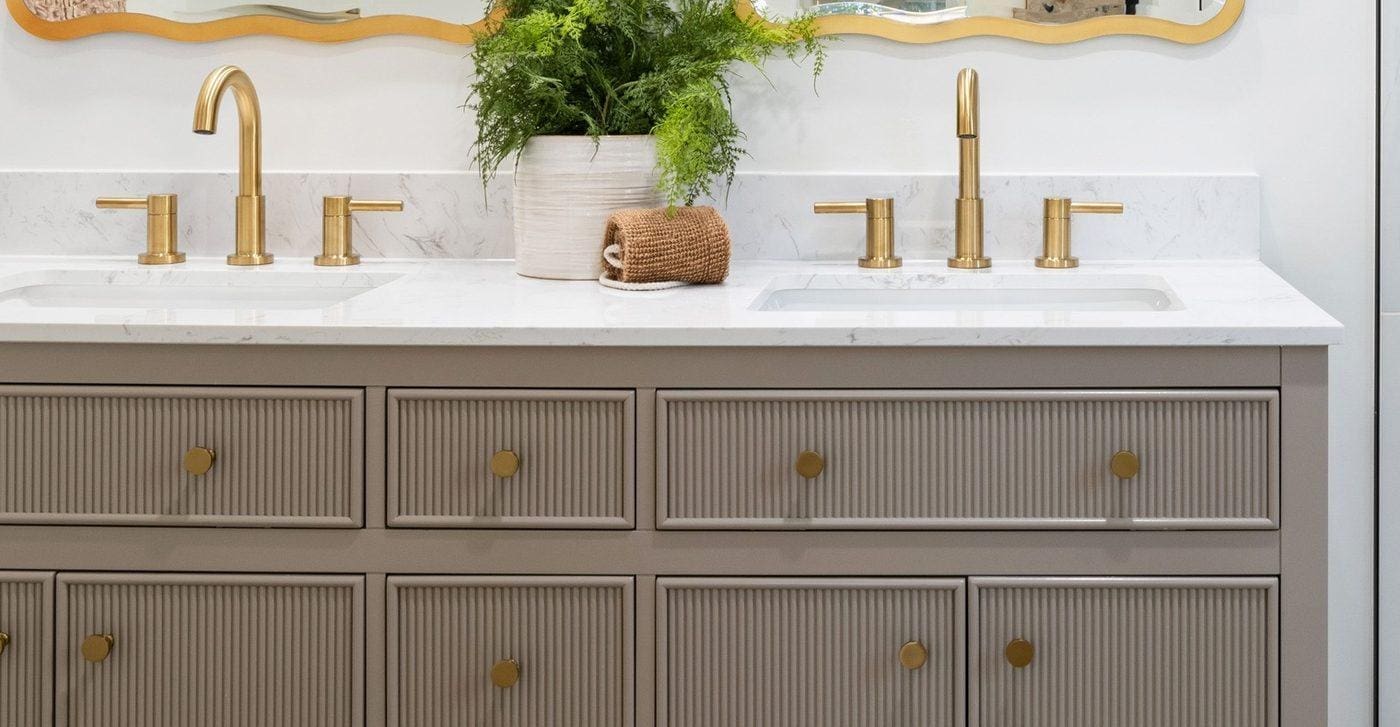
Most bathroom fixture decisions come down to a single question homeowners don’t always think to ask: does everything in the room need to match? On a recent Land Park bathroom remodel, the answer was no; the dual vanity was finished in warm, brushed gold, while the walk-in shower just a few feet away runs matte black. Here’s a closer look at how that pairing works, and what it takes to pull off mixing two fixture finishes in one small room without it looking like an afterthought.
Gold Where You Touch It Most
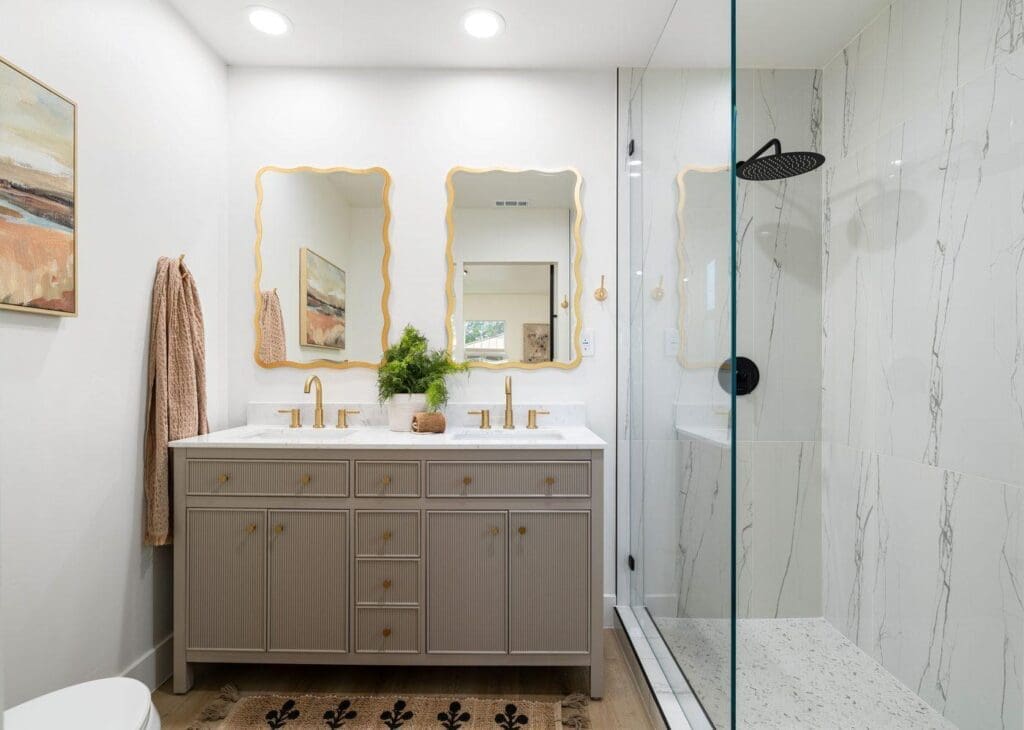
The vanity is where this bathroom spends its gold budget: a pair of brushed-gold gooseneck faucets, matching gold cabinet knobs across the fluted lower cabinets and drawer fronts, and two scalloped mirrors framed in the same warm gold tone. Grouping every gold element on one wall, rather than scattering a gold towel bar here and a gold light fixture there, is what keeps the finish from feeling arbitrary. It reads as one deliberate design decision instead of several small ones made independently.
One Room, Two Metals, No Clash
Step a few feet to the right, and the finish changes completely; the walk-in glass shower’s rain head, door hardware, and drain are all matte black bathroom fixtures, the same finish this series covered on its own in an earlier Land Park post. Mixing metals like this only works when each finish is confined to its own zone: gold stays on the vanity’s plumbing and hardware, black stays on the shower’s. Nothing on the vanity is black, and nothing in the shower is gold, so the eye reads two clear, intentional zones rather than a mismatched fixture package.
Why the Cabinetry Doesn’t Fight the Fixtures
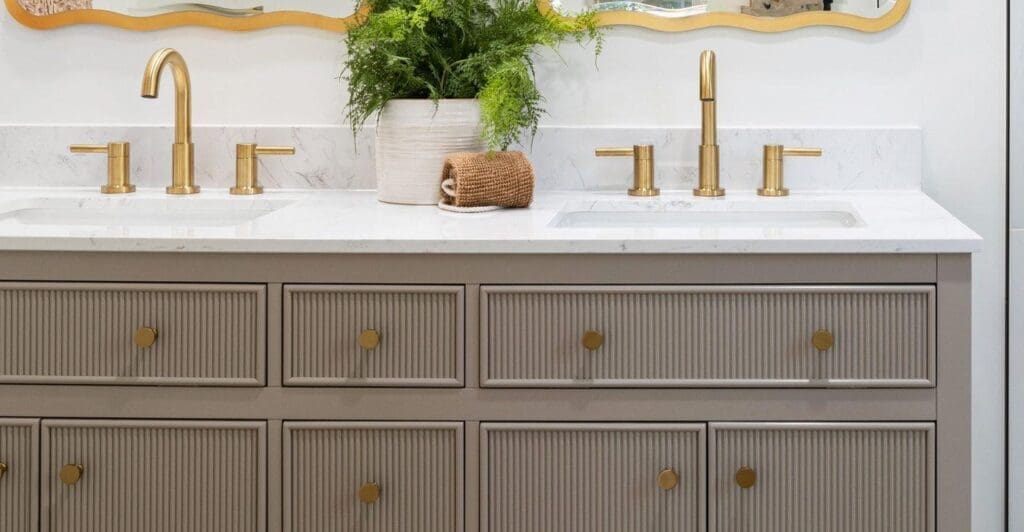
The two-tone gray vanity cabinetry, fluted door and drawer fronts in a soft greige, is a deliberately neutral base for the gold hardware to stand out against. A darker or busier cabinet finish would compete with the faucets and knobs for attention; a lighter, textured neutral lets the gold do the visual work instead. The matching gold pulls on every drawer and door reinforce the same finish story across the full width of the vanity, not just at the sink.
Considering a Bathroom Remodel of Your Own?
A fixture-finish decision like this one is a small line item on a larger bathroom remodeling project, but it’s one of the details that makes a finished bathroom look designed rather than assembled. At America’s Advantage Remodeling, we’ve been doing this kind of work in the greater Sacramento area since 2001, and we’re happy to walk through your bathroom with you and figure out what finish pairing makes sense for your space. Reach out for a free in-home consultation.
Frequently Asked Questions
Q: Do gold bathroom fixtures work with gray cabinetry?
A: Yes, a warm, brushed or unlacquered gold pairs especially well with a cool or greige-toned gray vanity, since the warmth of the metal keeps the cabinetry from reading flat or cold. Polished, high-shine gold can look dated against gray if it’s overused, which is why most designers limit it to faucets, cabinet knobs, and mirror frames rather than covering every surface.
Q: Can you mix gold and black fixtures in the same bathroom?
A: Yes, and it’s an increasingly common way to keep a bathroom from feeling too matched. Gold on the vanity (faucets, hardware, mirror frames) and matte black on the shower (shower head, door hardware, drain) gives each fixture zone its own identity while still reading as intentional, since both are warm-to-neutral finishes rather than clashing tones. The key is grouping each finish by zone instead of alternating randomly within the same surface.
Q: Are gold bathroom fixtures more expensive than chrome or brushed nickel?
A: Generally yes, though the gap has narrowed; a gold or brushed-brass faucet from a mid-range plumbing brand typically costs somewhat more than the same model in chrome, mainly due to the PVD (physical vapor deposition) finishing process used to make the color fade- and tarnish-resistant. Budget vanity hardware in gold tends to cost about the same as any other finish.
Q: Does gold bathroom hardware tarnish or wear off over time?
A: A quality PVD-finished gold fixture is bonded at a molecular level and resists tarnishing, scratching, and fading far better than older gold-tone finishes from decades past, which is part of why the trend has returned. Most manufacturers back PVD finishes with a multi-year or lifetime finish warranty. A cheaper lacquered-brass finish, by contrast, can wear through with daily use and shouldn’t be confused with true PVD gold.
Q: What cabinet hardware pairs best with a gold faucet?
A: Matching or closely coordinating cabinet knobs and pulls in the same gold tone as the faucet is the most common approach, since it ties the plumbing fixtures and the cabinetry together as one finish story rather than two separate decisions. A round gold knob on fluted or paneled cabinet doors is a common, proven combination for exactly this reason.
Q: Is a gold faucet a good choice for a bathroom that gets daily use?
A: Yes, as long as it’s a genuine PVD or similarly durable finish rather than an inexpensive lacquered coating, daily use is exactly the scenario PVD finishes are built for, since they’re tested for scratch and wear resistance the way a kitchen faucet finish would be. It’s a reasonable upgrade for a primary or shared bathroom, not just a guest bath that sees light use.
CONTACT US
Our Services
Areas We Serve
Certificate