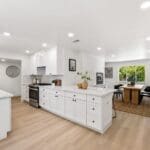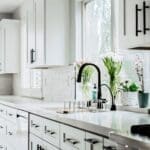
I’m Eugene Chernioglo, and here’s the straight story on open shelving in a kitchen remodel: it’s not just a Pinterest trend, and it’s not right for every kitchen either. On a recent kitchen, bathroom, and interior remodel we completed in East Sacramento (95819), the homeowners swapped a run of upper cabinets for open wood shelving flanking the range hood — and paired it with a navy waterfall-edge island. Here’s what that decision actually looks like day to day, what it costs, and how to know if it’s the right call for your own kitchen.
Why Homeowners Are Rethinking Upper Cabinets
Upper cabinets do one job well: they hide things. But they also box in a kitchen visually, especially a smaller one, and a lot of what ends up behind those doors is used maybe once a month. Open shelving flips that logic — it puts your everyday dishes, glassware, and a few good-looking pieces in easy reach, and it opens up sightlines to the ceiling instead of a wall of doors. It’s not the right move for every cabinet run in the kitchen, but it’s a strong one for the section right around a range hood or a prep zone, which is exactly where we used it on this project.
What Open Wood Shelving Actually Replaces
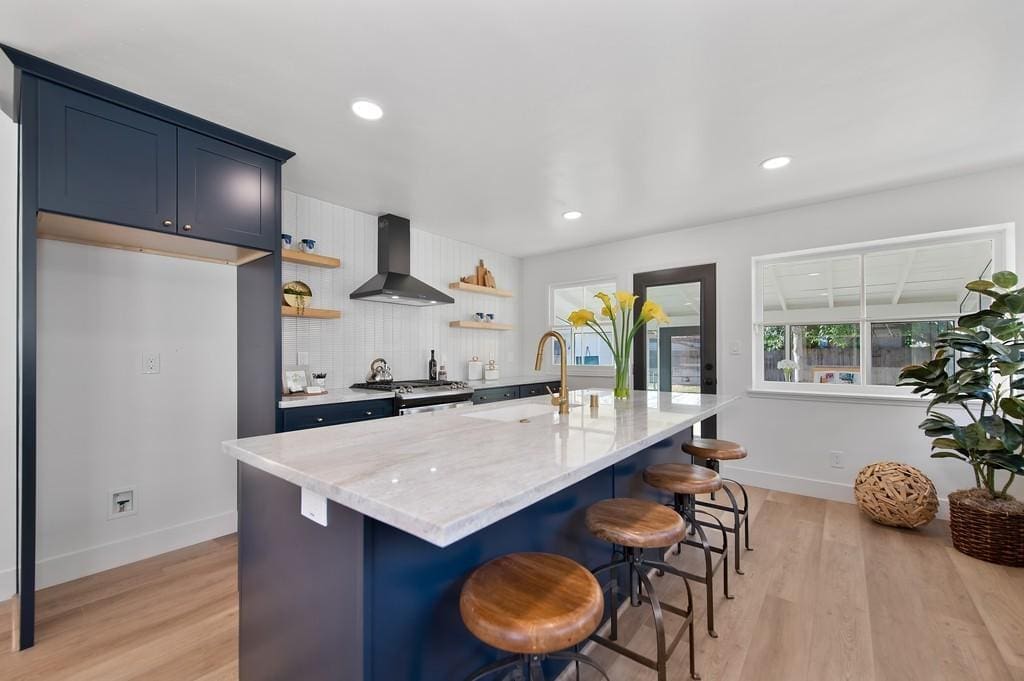
On this East Sacramento kitchen, we removed the upper cabinets that would normally flank the range hood and replaced them with two floating wood shelves on each side. The navy shaker cabinetry below stayed fully closed-storage, so the homeowners didn’t lose any actual storage capacity — they just relocated the visible, frequently-used items (everyday plates, mugs, cutting boards, a few styled bowls) up onto the shelves, and kept the less-visited stuff in the closed cabinetry elsewhere in the kitchen.
That’s the pattern we’d recommend for most kitchens considering this: don’t go all-in on open shelving everywhere. Pick the one or two runs where you actually want quick, visible access, and leave the rest of your upper cabinet storage closed. A kitchen with zero closed upper storage almost always ends up feeling less functional within a year, not more.
Cost, Materials, and What to Actually Store Up There
Simple floating wood shelves like these typically run $150–$400 per shelf installed, including the wood, finish, and bracket hardware — a fraction of the cost of an equivalent run of upper cabinets. Solid oak, walnut, and maple are the most common choices because they hold up to daily kitchen use and take a clear or lightly-tinted finish well. On this project, a warm natural wood tone was chosen specifically to contrast against the navy cabinetry, which is what makes the shelving read as a deliberate design choice instead of an afterthought.
As for what belongs on open shelves: everyday dishware, glasses, a stack of bowls, cutting boards, and a handful of styled items (a vase, a cookbook, a small plant) work well. Things that don’t belong there: small appliances, mismatched food storage containers, anything greasy that sits directly over a burner, or anything you’d be embarrassed to have a dinner guest see. If it’s not something you’d want on display, it belongs behind a door.
Pairing Open Shelving With a Waterfall Island
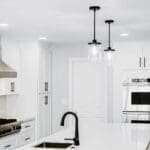
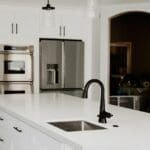
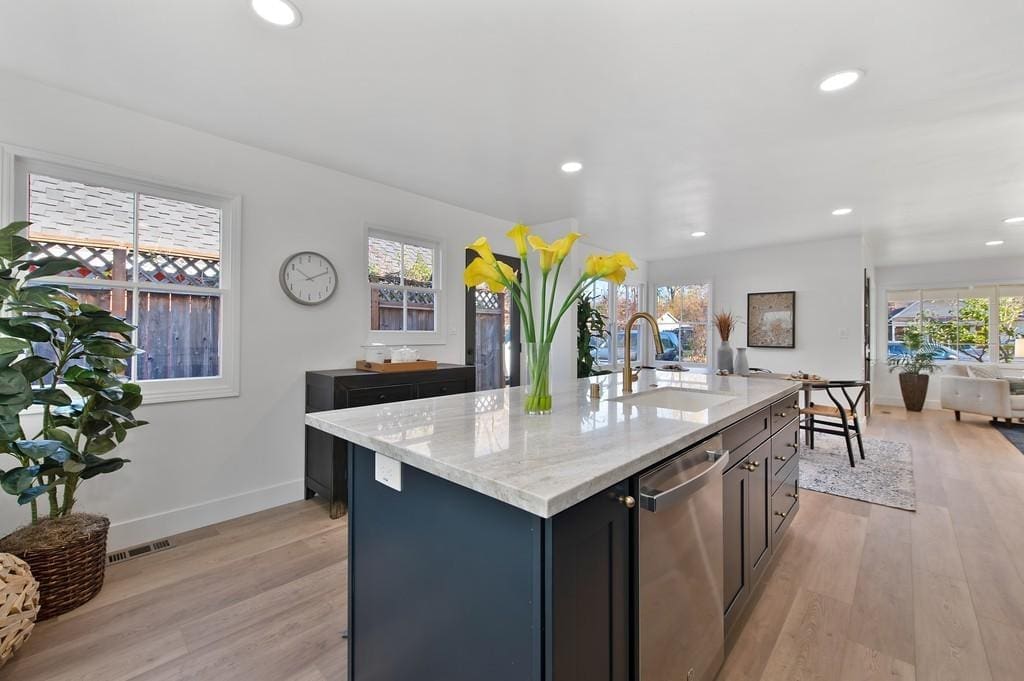
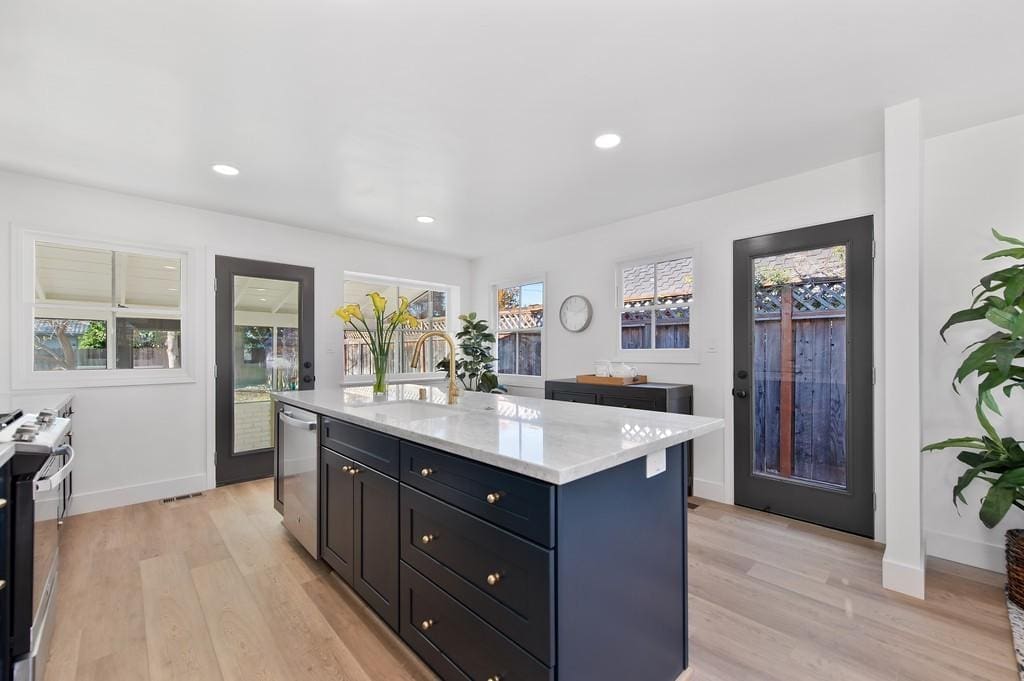
This kitchen’s open shelving doesn’t work in isolation — it’s part of a bigger layout that also includes a navy waterfall-edge quartz island with bar seating, visible in the wider view below. We won’t go deep on waterfall island design here since we’ve already covered that in detail elsewhere (see the internal link below); the short version is that the same navy-and-wood-tone contrast used on the shelving carries through to the island, which is what ties the whole kitchen together visually rather than reading as two separate design decisions.
Ready to Rethink Your Kitchen Storage?
Open shelving isn’t right for every kitchen, but if you’re tired of a wall of upper cabinets and want a look that feels lighter and more personal, it’s worth a real conversation with a designer who can tell you which runs make sense to open up — and which ones should stay closed. At America’s Advantage Remodeling, we’ve been doing this work in the Sacramento area since 2001, and we’re happy to walk your kitchen with you and figure out what fits. Reach out for a free in-home consultation and we’ll show you what’s possible.
Frequently Asked Questions
Q: Is open shelving in a kitchen a bad idea?
A: Open shelving works well when you’re intentional about what goes on it — everyday dishware, glassware, and a few styled pieces, not the whole pantry. It’s not a bad idea, but it’s not a drop-in replacement for every upper cabinet either; most homeowners keep at least one or two closed cabinets nearby for small appliances, mismatched containers, and anything they don’t want dusted weekly.
Q: Do open shelves get dusty and greasy?
A: Yes, more than a closed cabinet does, especially the shelf closest to the cooktop. In this East Sacramento remodel, the open shelves sit beside the range hood rather than directly above the burners, which keeps grease buildup manageable. A quick wipe-down every week or two is realistic; daily maintenance is not required unless the shelves sit directly in the cooking zone.
Q: How much does it cost to add open shelving to a kitchen remodel?
A: Simple floating wood shelves typically run $150–$400 per shelf installed, including bracket hardware and finish work, far less than an equivalent run of upper cabinets. The bigger cost driver is usually what’s happening elsewhere in the kitchen at the same time — new cabinetry, a waterfall island, or a full layout change — not the shelving itself.
Q: What wood works best for open kitchen shelves?
A: Solid oak, walnut, and maple are the most common choices because they hold up to daily use and take a clear or lightly-tinted finish well. In this project, a warm natural wood tone was chosen specifically to contrast with the navy cabinetry below — a pairing that reads as intentional rather than mismatched.
Q: Should open shelving replace all of my upper cabinets?
A: Usually not entirely. The most functional kitchens use open shelving to replace one or two runs of upper cabinets — typically near a range hood or a sink, where you want frequently-used items in easy reach — while keeping closed storage everywhere else. A kitchen with zero closed upper storage tends to feel less practical day to day.
Q: Does open shelving work in a small kitchen?
A: It can, and it often helps a small kitchen feel less boxed-in than a wall of upper cabinets does, since it keeps sightlines open to the ceiling. The tradeoff is that a small kitchen has less room to hide clutter, so open shelving in a tight space works best when paired with strong closed storage elsewhere, like a full-height pantry wall.
CONTACT US
Our Services
Areas We Serve
Certificate