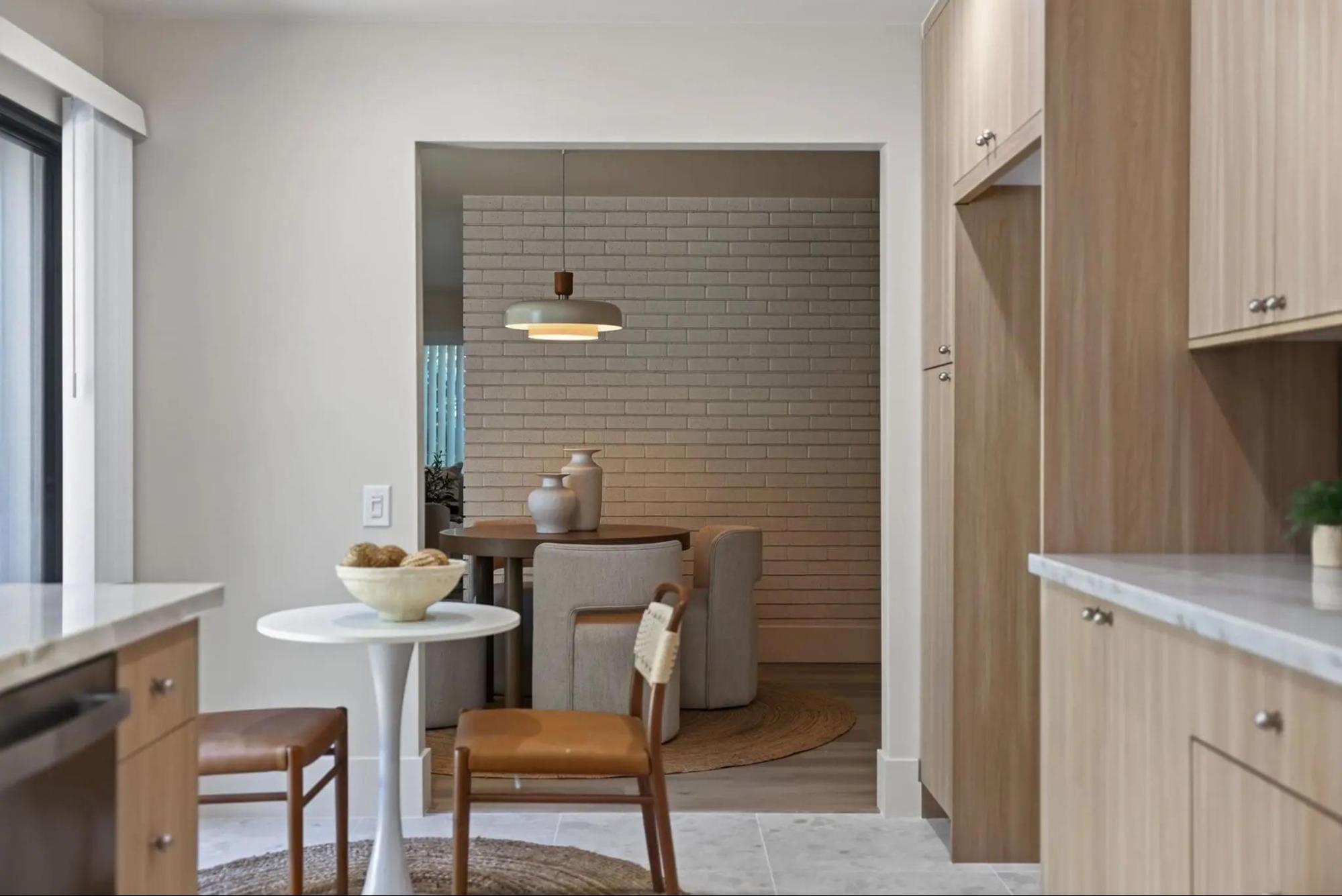
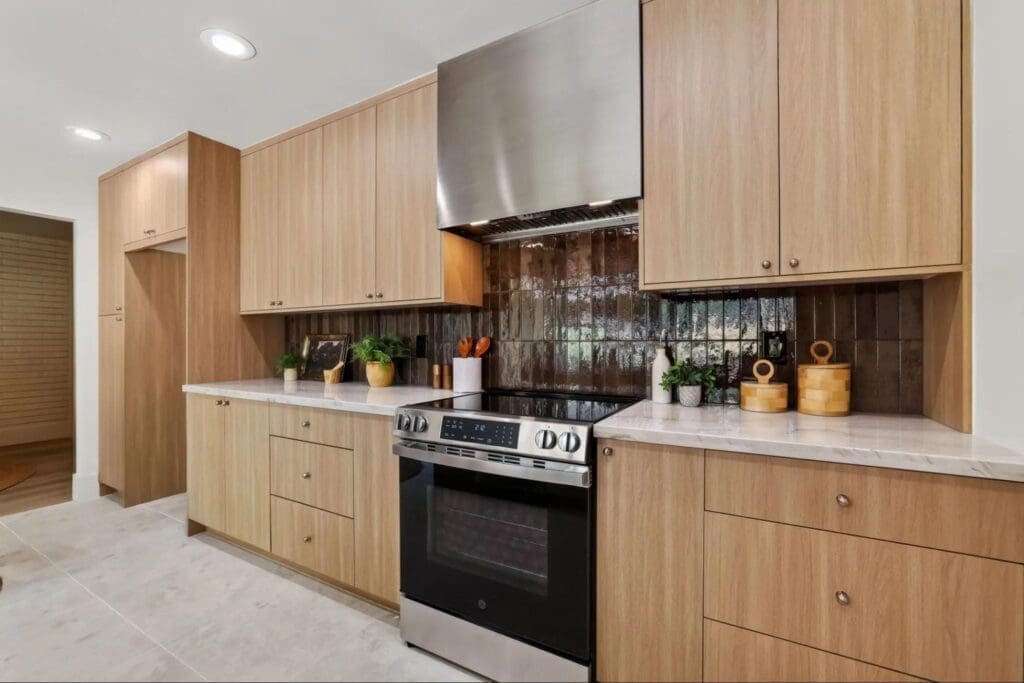
I’m Eugene Chernioglo, and after 25 years of kitchen remodels in the Sacramento area, I can tell you the shaker-cabinet debate isn’t as settled as it looks online. On a recent kitchen remodel we completed for a homeowner near Elk Grove — the kind of project that comes out of our Franklin-area and Elk Grove client base as often as it does anywhere else in Sacramento County — we went a different direction: floor-to-ceiling flat-panel cabinetry in a warm white oak tone, no shaker doors anywhere in the room. Here’s why more homeowners in this corridor are asking for that look, what it costs compared to shaker, and what to know before you commit to it.
Flat-Panel vs. Shaker: What Actually Changes
A shaker door has a recessed center panel framed by a squared edge — it’s the cabinet style most homeowners picture by default, and for good reason, it’s been the safe choice for years. A flat-panel (or slab-style) door skips all of that: one smooth, flat surface, no grooves, no raised trim. On this project, that flat surface runs the full height of the room, floor to ceiling, which is where the look really separates itself from a standard flat-panel kitchen that only goes up to a normal 36-inch upper-cabinet line.
Why Floor-to-Ceiling Changes the Math
Most kitchens leave a foot or two of dead space above the upper cabinets — a dust-collecting gap that either sits empty or gets used for decor nobody dusts. Running the cabinetry floor-to-ceiling eliminates that gap entirely and adds real, usable storage up top for things you access once or twice a year: seasonal serveware, large platters, small appliances you don’t want on the counter. It also does something for the room visually that a standard-height kitchen can’t: it pulls the eye straight up, which makes even a modest-sized kitchen read as taller and more spacious rather than boxed-in.
The tradeoff is access — the top sections of a floor-to-ceiling run usually need a step stool, so we typically reserve that top zone for the least-frequently-used items and keep everyday dishware within normal reach, the same way we’d plan any other cabinet layout.
Hardware, Cost, and What to Expect
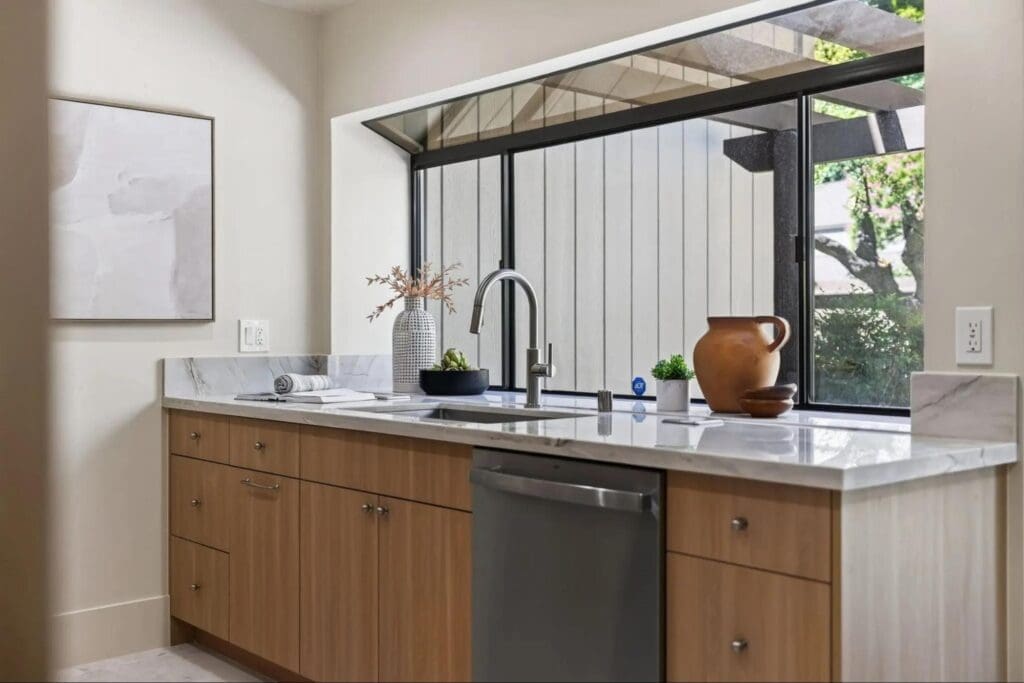
Flat-panel doors are often slightly cheaper to manufacture than shaker doors, since they skip the recessed-panel milling step — but that price gap narrows fast once you add a floor-to-ceiling run, a premium wood-grain finish like the white oak tone here, or integrated/push-to-open hardware instead of standard pulls. Most flat-panel kitchens lean toward slim bar pulls or simple knobs rather than anything ornate, since the whole point of the style is an uninterrupted, clean-lined surface — busy hardware works against the look rather than with it.
On the practical side, flat-panel surfaces show fingerprints and water spots a little more readily than a textured or recessed-panel door, especially in a matte finish. That’s a minor tradeoff most homeowners find worth it for the look, but it’s worth knowing going in rather than being surprised by it after move-in.
Considering This Look for Your Own Kitchen?
Floor-to-ceiling flat-panel cabinetry isn’t the right call for every kitchen or every budget, but for homeowners in the Elk Grove and Franklin area who want a clean, modern look without sacrificing storage, it’s one of the strongest options we install. At America’s Advantage Remodeling, we’ve been doing this work in the greater Sacramento area since 2001, and we’re happy to walk your kitchen with you and talk through whether this style fits your space. Reach out for a free in-home consultation.
Frequently Asked Questions
Q: What are flat-panel (slab) kitchen cabinets?
A: Flat-panel, or slab-style, kitchen cabinets have a completely smooth, flat door front with no recessed center panel, grooves, or raised trim — the opposite of a shaker door’s framed look. They’re the foundation of a modern, minimalist kitchen, especially when they run floor-to-ceiling instead of stopping at a standard upper-cabinet height.
Q: Are flat-panel cabinets more expensive than shaker cabinets?
A: Not necessarily — flat-panel doors are often less expensive to manufacture than shaker doors because they skip the recessed-panel milling step, though the price gap narrows or reverses once you add floor-to-ceiling runs, integrated hardware, or a premium wood-grain finish like the white oak tone used in this Elk Grove-area remodel.
Q: Do flat-panel kitchens need special hardware?
A: No, but most homeowners pair them with slim bar pulls or knobs rather than the ornate hardware sometimes used on shaker doors, since the whole point of the slab look is a clean, uninterrupted surface. Some flat-panel kitchens skip visible hardware entirely in favor of push-to-open or integrated finger-pulls, though that’s a separate decision from the cabinet style itself.
Q: Do floor-to-ceiling cabinets make a kitchen feel bigger or smaller?
A: Floor-to-ceiling cabinetry almost always reads as more spacious, not less, because it eliminates the awkward dead space above standard upper cabinets and draws the eye straight up to the ceiling line. That vertical continuity is part of why this style pairs so naturally with the flat, seamless look of slab-style doors.
Q: Will flat-panel cabinets go out of style?
A: Flat-panel cabinetry has held steady as a modern-kitchen staple for over a decade, largely because its minimalism doesn’t depend on a specific color trend the way some finishes do. It’s a safer long-term bet than a heavily trend-driven look, especially in a neutral wood tone like the white oak finish shown here.
Q: What’s the difference between flat-panel and frameless cabinets?
A: They’re related but not identical: “flat-panel” describes the door style (a smooth, flat front), while “frameless” describes the box construction (no face frame around the cabinet opening). Most modern flat-panel kitchens, including this one, use frameless boxes as well, since the two choices are usually made together to maximize interior storage space and reinforce the clean-lined look.
CONTACT US
Our Services
Areas We Serve
Certificate